
All my posts are freely accessible, but this work is only possible thanks to reader support. If you find it worthwhile, please help out with a paid subscription through Substack (discounted here) or on Patreon.
You can also make a one-time donation here.
Many thanks.
The fireworks have died down, the casualties have been counted, and the hangovers have mostly faded. Here comes 2026.
Ready or not.
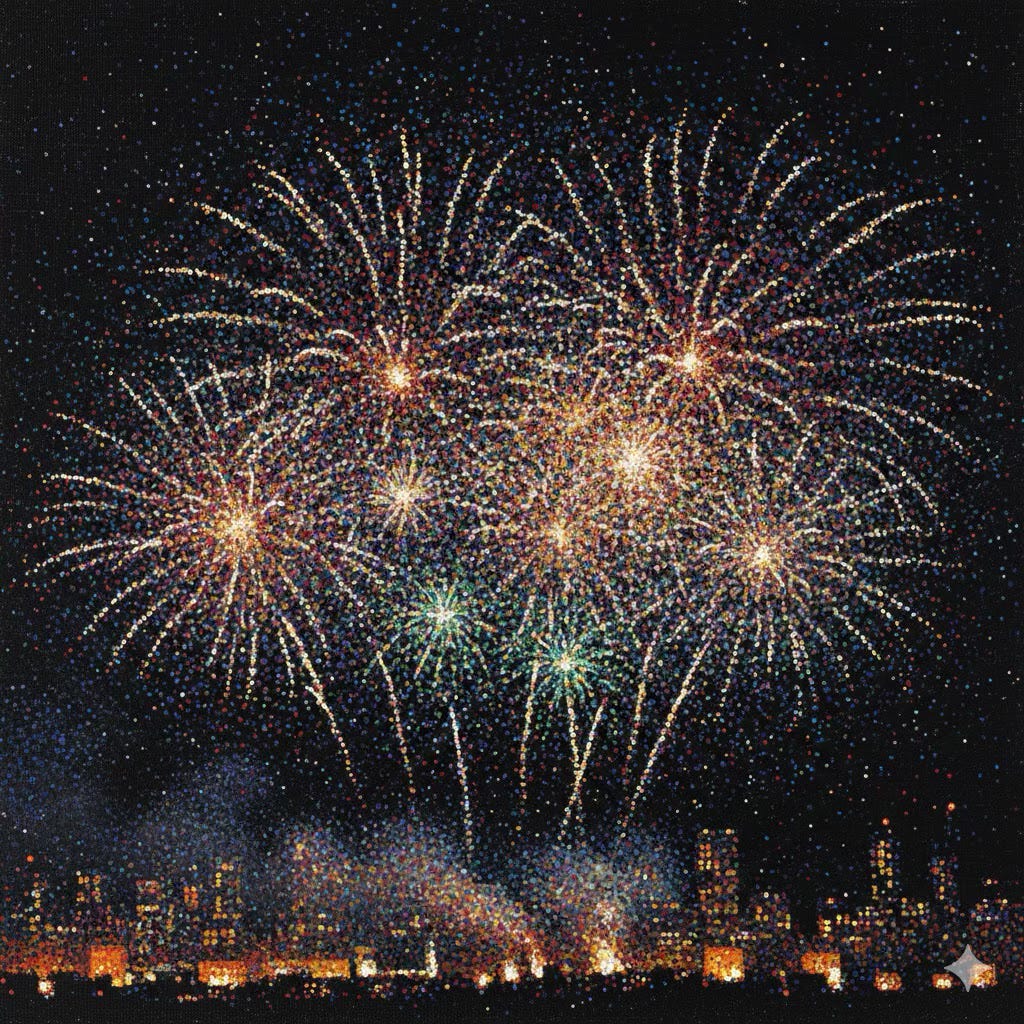
I loved fireworks as a kid, but I’ve since grown to hate them. They’re loud, distracting, and insensitive to war survivors. They’re also an environmental disaster and a traumatic event for animals. In my neighborhood, the professionals in the park are outmatched by amateur ordnance enthusiasts who add a certain “explosive zeal” to the local chaos.
Some people say that fireworks are part of America’s fetish for violence. Is that true in some cases, with some people? Probably. But is that the whole story? I’m not so sure. For one thing, Americans aren’t the only ones who love to blow sh*t up in the darkness. Many of my neighbors celebrate Nochebuena on Christmas Eve with amateur fireworks, for example.
Our Fourth of July fireworks are said to commemorate the survival of Fort McHenry during the Revolutionary War. That occasion was memorialized in Francis Scott Key’s poem—which, of course, provided the lyrics for our national anthem.
I’ve never been thrilled about having a national anthem that celebrates violence. I sympathize with those who think that “This Land is Your Land” would be a good substitute. (My personal preference, however, is “What’s Going On” by Marvin Gaye. Who’s with me?)
But the Star-Spangled Banner invokes one of our most primal human emotions: the uplifting sight of dawn, of light, after a long night of danger and fear. My theory is that its popularity centers on that word, “light”; it appears in the poem’s very second line. As for the “rocket’s red glare” and “bombs bursting in mid-air”: yes, they’re harsh images. But it’s also possible to see the song as celebrating their light, not their violence. It was their light, after all, that gave “proof through the night”—through that long, terrifying, deadly night—that hope was not lost.
Celebrations during this dark season serve the same purpose. Ten days ago or so we experienced the longest night of the year, the Winter Solstice, which is celebrated with the ancient festival of Yalda Night (Shab-e Yaldā) in places like Iran, Afghanistan, and Tajikistan. Iranians mark this occasion with special foods and poetry readings, especially of the Sufi poet Hafiz. (Experts say that Hafiz has never been translated well, because his use of words is inseparable from his native language. It’s true that I’ve read some cringe-inducing English translations of Hafiz. But even when badly translated, he’s a more interesting poet than Francis Scott Key.)
The ancient Romans had Saturnalia, a festival that celebrated the reversal of the sun’s movement by reversing social roles. Slaves became masters, and masters became slaves—if only temporarily.
Which gets us to another word: revolution.
The Winter Solstice marks one end of an annual earth cycle. At the other end is the Summer Solstice, typically a time of abundance and light. It’s a reversal in direction—a revolution. No wonder slaves became masters and master became slaves.
As I understand it, the word “revolution” was first used in its political sense because of Aristotle’s belief that civilizations, like planets, exist in cycles. If he was right, every corrupt and dictatorial regime already contains the seed of its own destruction. Another revolution is inevitable. Tyranny is always doomed to fail. What goes around, comes around.
That thought should get some of us through these long winter hours.
Like a dictatorship, the darkest night of the year contains the seed of its own destruction. I guess that’s why we light candles, and bonfires—and yes, rockets. The rocket’s red glare, the fireworks on an otherwise peaceful winter night ... I still hate all that sound. But I’m beginning to appreciate the light.
Thank you for this lovely essay.
It reminds me of the COVID period, when my near neighbors designed one of the most spectacular decentralized fireworks displays (of many!) in Philly. The cops blocked their street off and did not intervene, which made me suspect that the local ordinance specialist had had a more official job in other years' fireworks. A varied and beautifully punctuated display soared outside my bedroom window.
Yes to light and hope.
We need a bouleversement repudiating fascism, mendacity & insipidity