
Congress will look very different next year, but I’m still thinking about the urban vote. Cities remain the leading edge of what might be called the New Left Wave. Democratic socialists have already been elected in Seattle WA and New York City and will almost certainly win in Los Angeles and Washington DC this November.
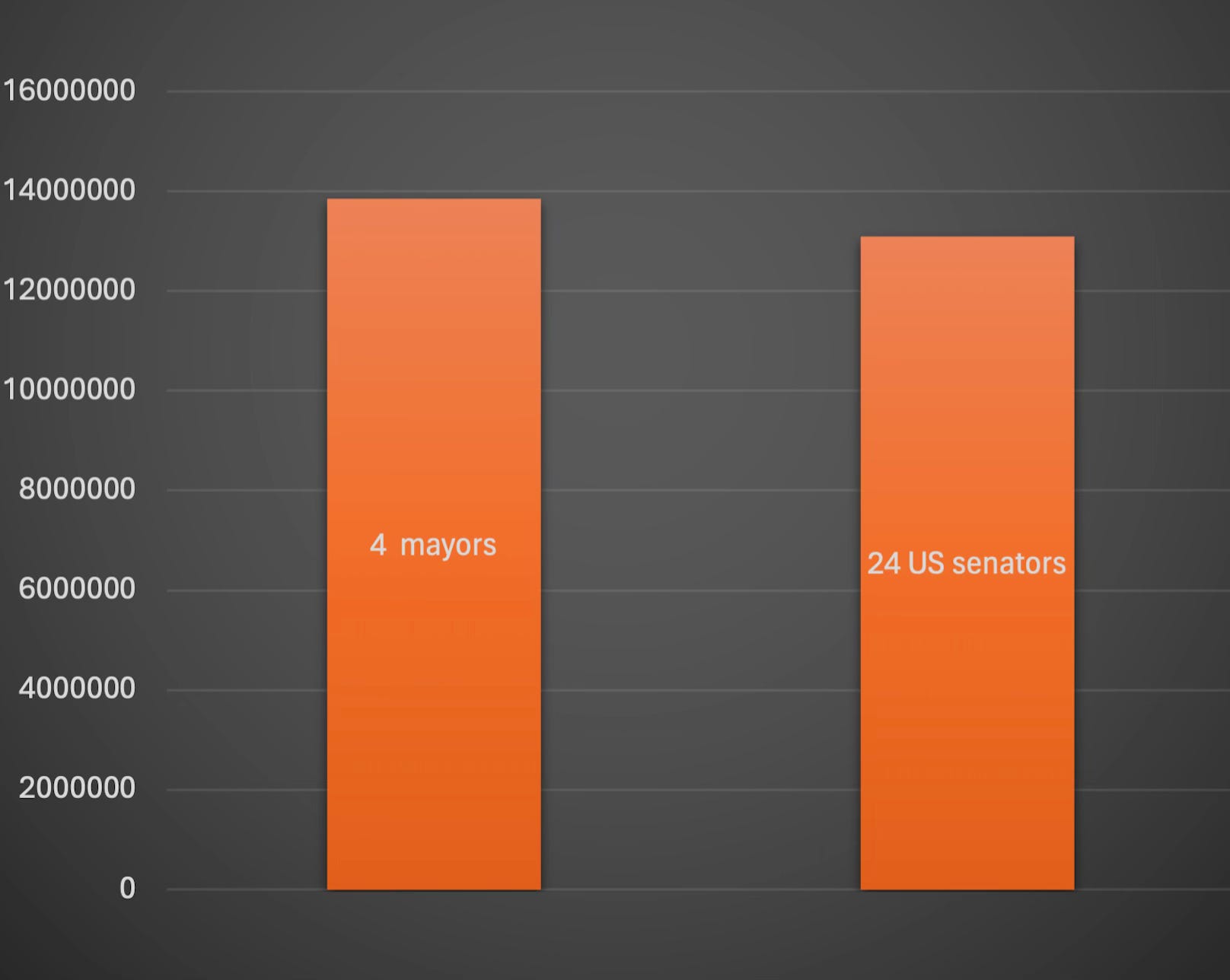
That means that (barring the unexpected events) leftists will soon represent a total population of 13,846,155 people, including the nation’s two largest cities. That’s more people than live in 46 of this country’s 50 states.
It’s also more than the total population of twelve US states put together: West Virginia, Hawaii, New Hampshire, Maine, Montana, Rhode Island, Delaware, South Dakota, North Dakota, Alaska, Vermont, and Wyoming.
Those states have a total population of 13,099,294 people—almost ten percent less than the population of these cities—and they’re represented by 24 senators in the United States Congress.
The United States Senate is highly un-representative, a relic of slavery days whose useful days (if it ever had any) are long behind it. But here’s a thought exercise: imagine an alternative electoral system which elected its solons on a truly democratic one-person, one-vote basis. In that world, democratic socialists could represent one/fourth of the country’s legislature.
Or, to put it another way: In a more representative democracy, democratic-socialist New Wave leftism would already be a major political force.
Which means that democratic socialism is no longer a fringe phenomenon—unless you think urban living itself is a fringe phenomenon.
(Some people still do, unfortunately. Their bias blinds them to many aspects of city life, including their rich geographic variations. Parts of Los Angeles can seem almost rural, for example, and every city contains vast differences in wealth, ethnicities, and subcultures.)
Palestine was a major factor in the mayoral, as well as congressional, races but it’s still the economy (I don’t want to say “it’s the economy, stupid,” like Clinton’s cynical crew did. How about “It’s the economy, beautiful soul”?) Economic struggle and economic justice aren’t just the new wave’s primary themes. They’re its best chance to become a lasting and transformative movement (because, let’s face it, this broken system isn’t going to fix itself.)
But you knew that.
Red Scare? Nobody cares.
It looks like the elites have finally figured out that, at least in the cities, the old Red Scare tactics don’t work anymore. Roughly half of this year’s voters are expected to be Millennials or Gen Z, which means they have no memory of the Cold War. Attempts to call leftists “communists” are more likely to be met with an “OK Boomer”—or a yawn—than a frisson of fear.
But the survival and growth of this movement depends on the ability of these elected officials to both govern effectively and communicate well—especially if they hope to advance in other parts of the country. They can do it (Bernie did remarkably well in West Virginia) but it won’t be easy, especially with so many powerful interests arrayed against them. They’ll need a steady influx of ideas. They’ll also need to be supported—and frequently challenged—by a well-organized activist movement.
And any sense that these elected officials are betraying their supporters (call it the “Fetterman effect”) could have devastating effects—on those politicians, and on the movement they represent.
This work is only possible thanks to reader support. If you find it worthwhile, please help out with a paid subscription through Substack (discounted here) or on Patreon.
You can also make a one-time donation here. Many thanks.
NOTES
Buffalo NY’s India Walton also won her Democratic primary and was on track to become mayor, but she was betrayed by insider Democrats. There’s no sign, however, that this particular trick will be repeated anywhere else this year.
Population of cities that have (or expect to have) democratic socialist mayors:
Los Angeles: 3,814,607
New York City: 8,509,853
Seattle: 766,644
Washington, D.C.: 755,051
Total: 13,846,155
Only four states have more than 13.8 million people: California, Texas, Florida, and New York.
Socialist majority long ago absent Bolshevism.