
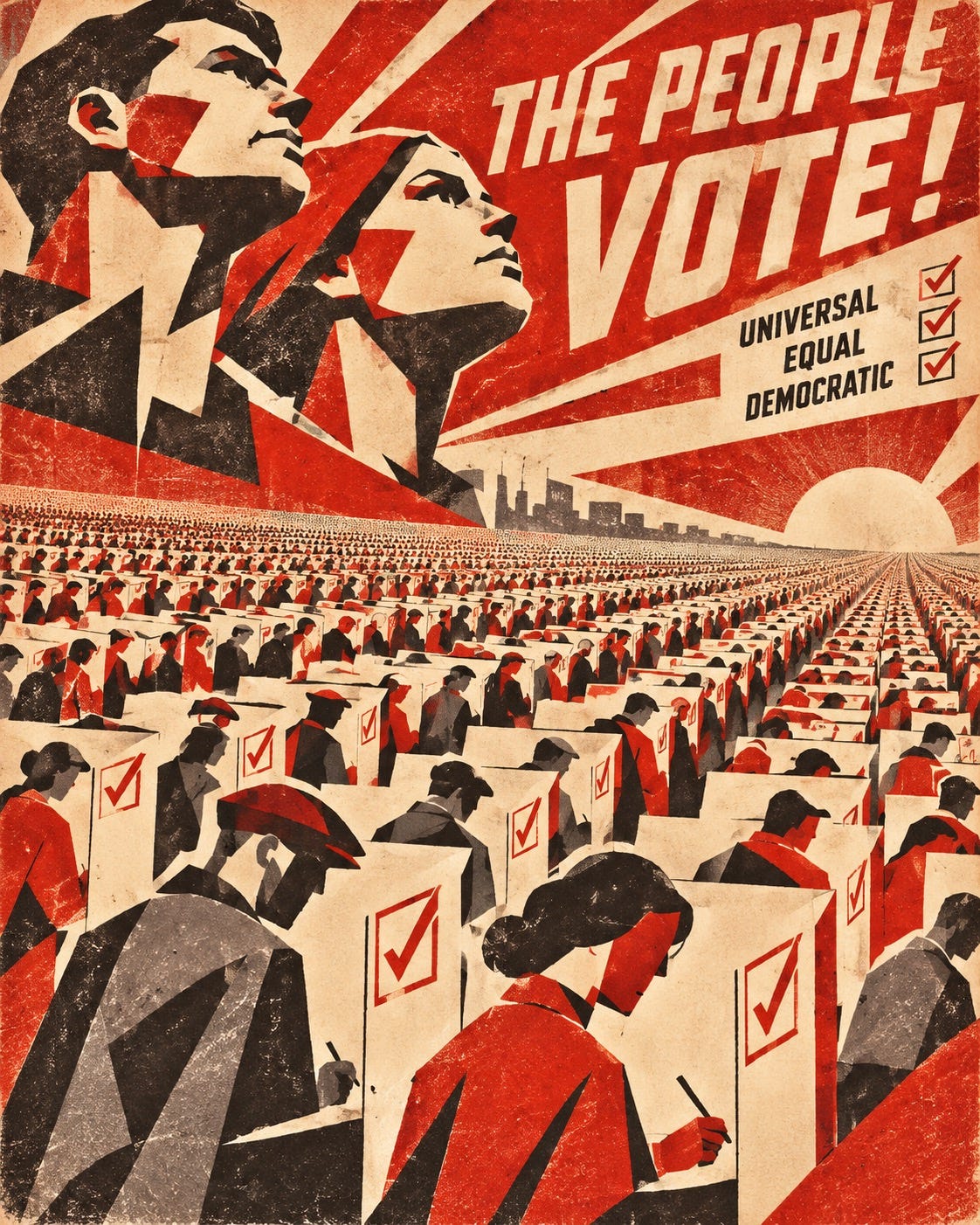
There have already been a lot of takes on this election and more are sure to come. Personally, I can’t stop thinking about the old American trope that says, “Your vote doesn’t matter.”
Politically-minded people hate that saying. Democracy, they say, depends on political engagement. I agree, but I also understand the disaffection. Let’s be honest: Your vote doesn’t matter. Neither does mine, or your neighbor’s, or anyone else’s. It is exceedingly rare for an election of consequence to turn on a single vote.
It doesn’t help that this country makes voting difficult, time-consuming, and costly (if you’re paid hourly). I was reminded of that last Tuesday as my ADHD-fragmented brain struggled with those seemingly simple instructions that can drive some of us insane. You know the ones: “Only color inside the oval but fill in the entire oval or your vote won’t be counted.” (I had to void my ballot and start again.) Or, “Put the punch card in this envelope with that end sticking out or your vote won’t be counted.”
It was like being back in elementary school in the 1950s and 1960s. Which is to say, it was hell. Moreover, I’ve been disenfranchised from presidential elections by that relic of slavery days known as the Electoral College, and from congressional elections by gerrymandering. It would be easy enough to be cynical and say that my vote has never changed anything. It wouldn’t even be wrong.
My vote doesn’t matter. But our votes matter—a lot. When tens of millions of people vote together, big things can happen. That’s why we do it.
The phrasing of that expression—“your vote,” “my vote”—reflects the hyper-individualism that pervades American political culture. It whispers to us with its hidden biases: If I the individual can’t change the world through my own, Horatio Alger-like ambition—preferably from the comfort of my keyboard—why should I even bother?
The forgotten X factor is the power of collective action. “Our,” “we,” “us”—these are words we should learn to use more often. So are “community,” “cooperation,” and the many other words that encourage us to build together.
Casting your ballot and getting your “I Voted” sticker can make us feel good about ourselves. I think that’s because we sense that we’ve connected with something larger than ourselves. Voting is a collective act. It binds us to each other and overwrites the learned helplessness that fuels our political despair.
Those positive feelings can motivate us to continue engaging in collective action—not just at election time, but all the time.
We need that more than ever now, because this is when the real work begins. The Democratic Party’s structure has a built-in resistance to change. It’s dominated by leaders who are more loyal to their big-money contributors than they are to the public at large. The next Congress will have more genuinely transformative leaders than any in recent memory. But they’ll need all the help they can get. They’ll need to be pressured sometimes, too. Legislators operate through compromise; movements must remind them where the moral lines are drawn.
When it comes to Congress, the priorities should be clear. First, the killing must end in Iran, Palestine, Lebanon, Yemen, and throughout the Middle East. Americans need, and want, Medicare for All and expanded Social Security. Congress must reject the Trump/Hegseth $1.5 trillion budget, but it must also go farther and cut the Pentagon’s already-bloated budget.
Most of all, Congress must break the billionaires’ stranglehold on American politics. We will not have a functioning democracy until big money is completely banned from campaign financing and is replaced by publicly-funded elections.
“But Trump will veto those things,” people say. Let him. Let the public see what, and who, the president and his party truly represent.
The alternative to this kind of bold action is the now-familiar cycle we might call the “Democratic doom loop.” Democrats won the White House and both houses of Congress in 2008, but the euphoria was short-lived. This year, people voted the way they did because they want change. Now, the Dems must give it to them. They won’t, unfortunately, at least while operators like Chuck Schumer and Hakeem Jeffries call the shots in Congress. Activists must not only demand policy changes. They must also demand major changes in the Democratic Party’s leadership and structure.
It’s a mistake, however, to think that movements exist merely to pressure and persuade elected officials. It is movements who lead, not politicians. Many politicians won on a platform that includes ending aid to Israel, reflecting a sea change in Americans’ attitude toward that country’s brutal occupation. For that we can thank the brave students who confronted authorities up and down the line—from the campus dean to the president of the United States—to defend the people of Gaza.
The emphasis on economic justice also reflects long years of movement activism, from Occupy Wall Street to the fight for Medicare for All. The people have led on these and other issues.
What is true of voting is also true of movement work. When we work together, people have far more power than we realize. The rhetoric of “rugged individualism” is designed to hide that power from us. That’s why the wealthy and powerful came up with it in the first place. They’re afraid of what might happen once we understand what we can accomplish.
That power—the power that belongs to all of us, working together—is the most important lesson of the 2026 election. Let’s use it wisely.